

Morse Code for Scouts
Last updated:
Table of Contents
Morse code has been part of scouting since Robert Baden-Powell's first Scouting for Boys in 1908. Today it shows up in the Signs, Signals, and Codes merit badge, in jamboree signaling games, on hiking trails as a fun cipher, and around the campfire as a quiet way to talk across the dark. This guide is for scouts working toward a badge, and for scout leaders looking for activities that turn an old skill into a memorable troop night.
The merit badge connection
In the BSA's Signs, Signals, and Codes merit badge (introduced in 2015, replacing the older Signaling badge from 1911–1992), requirement #5 asks the scout to demonstrate knowledge of one of several signaling systems. Morse code is one of the three traditional options:
Requirement #5: choose ONE signaling system
- • Morse code: Send and receive a 20-word message at 5 WPM, using sound, light, or written dot/dash
- • American Sign Language: Demonstrate fingerspelling and 25 common words
- • A "foreign" alphabet: Such as Braille: read and write a short message
Always check the current badge requirements on the official BSA website or in the latest Signs, Signals, and Codes Merit Badge Pamphlet. Requirements can change.
The merit badge also asks scouts to discuss the history of Morse code, identify common prosigns and abbreviations, and explain a use-case (commonly aviation NDB beacons or amateur radio).
Beyond the badge: where scouts actually use Morse
The badge is a great reason to learn, but Morse pays off in scouting long after the requirement is signed off. Common scenarios:
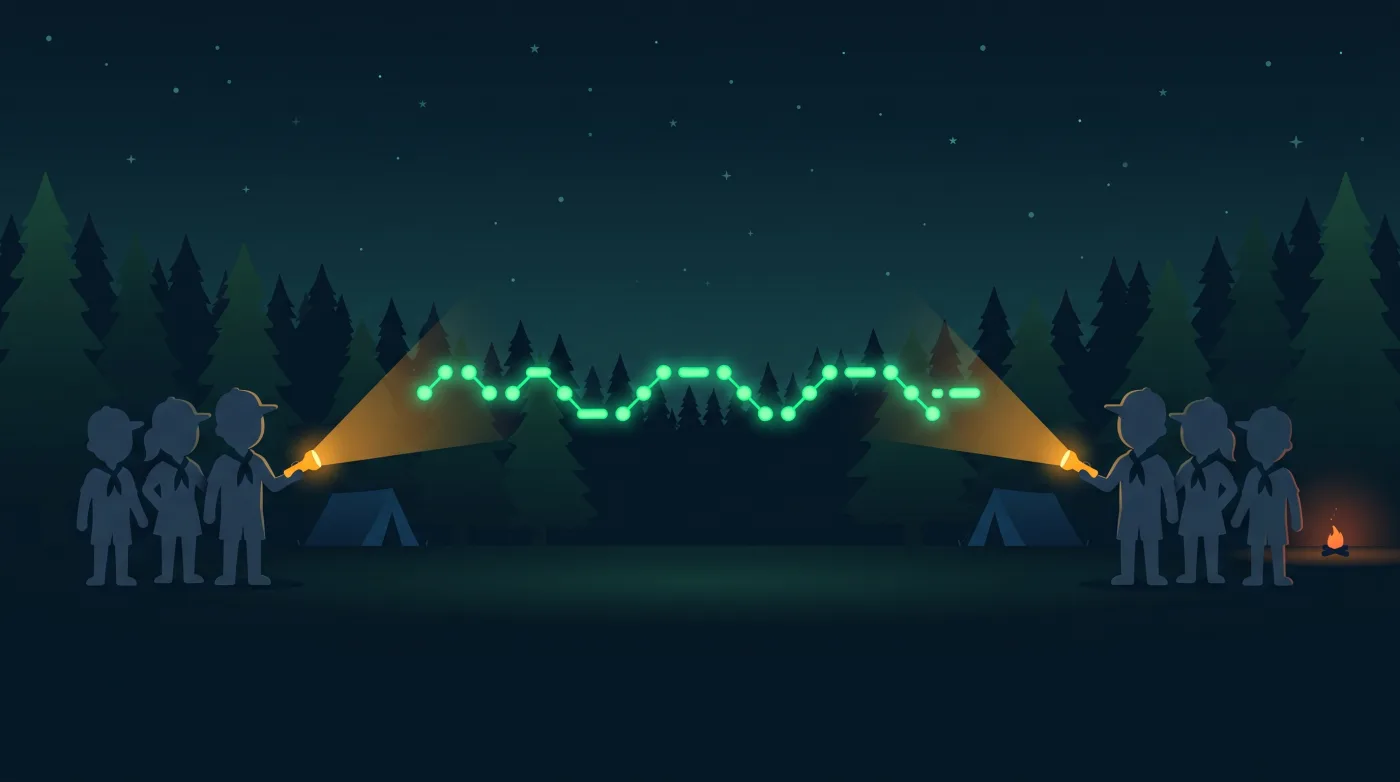
- • Camp signaling at night. A small flashlight can pass a quiet message between tents without waking anyone: "lights out", "all clear", "come over". Use our Flashlight Signaler from a phone or learn to do it by hand with a regular torch.
- • Treasure-hunt cipher. Translate clues into dots and dashes for a campwide hunt. Add a printable cheat sheet as the first clue.
- • Jamboree on the Air (JOTA). The largest scouting event in the world, held every October. Scouts make contacts with other troops worldwide using amateur radio, and CW is one of the modes used.
- • Survival and pioneering. Signaling for help with a whistle (short pip / long blast) or signal mirror is a real-world emergency skill that ties directly to wilderness survival training.
- • Order of the Arrow. Some lodges use Morse-coded recognition tokens, induction tradition, or trail ciphers as part of their lore.
A kid-friendly learning roadmap
5 WPM is achievable for any motivated 11-year-old in 2–4 weeks of short daily practice. The trick is to keep sessions short and game-like. Brain fatigue at this age sets in faster than for adults; 10–15 minutes done well beats an hour of frustration.
| Session | Activity | Goal |
|---|---|---|
| 1–3 | Learn SOS by ear. Practice sending it on a flashlight. | Recognize the distress signal anywhere |
| 4–7 | Learn E, T, A, I, M, N (the most common short letters) | Send and receive simple two-letter combinations |
| 8–12 | Add S, O, R, H, U, D, L (covers ~70% of English text) | Send your name and patrol name |
| 13–18 | Fill in the rest of the alphabet + digits 0–9 | Decode a 20-word message at 5 WPM |
| 19+ | Send and receive practice messages with another scout | Pass the merit badge requirement |
For drills, our Morse Code Quiz has a character mode that turns practice into a game with a personal-best timer (stored locally in the browser, no account needed, and kids love beating their own score).
Five Morse activities for a troop meeting
Pick one, run it as a 30-minute station, and watch the energy go up.
1. Flashlight relay
Split the troop into pairs across opposite ends of the meeting room (or campground). Each pair gets a flashlight and a different 5-word message. Send it to the other pair. First pair to correctly decode wins. Repeat with longer messages each round.
2. Whistle field game
Hide a small object in the field. The "spotter" knows where it is and signals directions with a whistle (short = dot, long = dash). The seeker must decode N/S/E/W instructions and walk in the right direction. Great for big open spaces.
3. Campfire cipher
Hand each patrol an envelope with a "secret message" in Morse: the location of their next campfire snack. Patrols race to decode and find the prize. Print a cheat sheet for each patrol if it's their first time.
4. Signal-mirror challenge
On a sunny day, demonstrate how to flash a single Morse letter with a signal mirror toward a "spotter" on a distant rise. It's surprisingly hard to aim. Most scouts will fail at first and then suddenly nail it. Powerful real-world survival drill.
5. Sound-only QSO
Pair two scouts at opposite ends of a corridor with the lights off. They can only communicate with a small clicker or pencil tap. Each must exchange name, patrol, and one fact about themselves, entirely in Morse. A great challenge for older scouts.
Morse vs. semaphore: a quick comparison
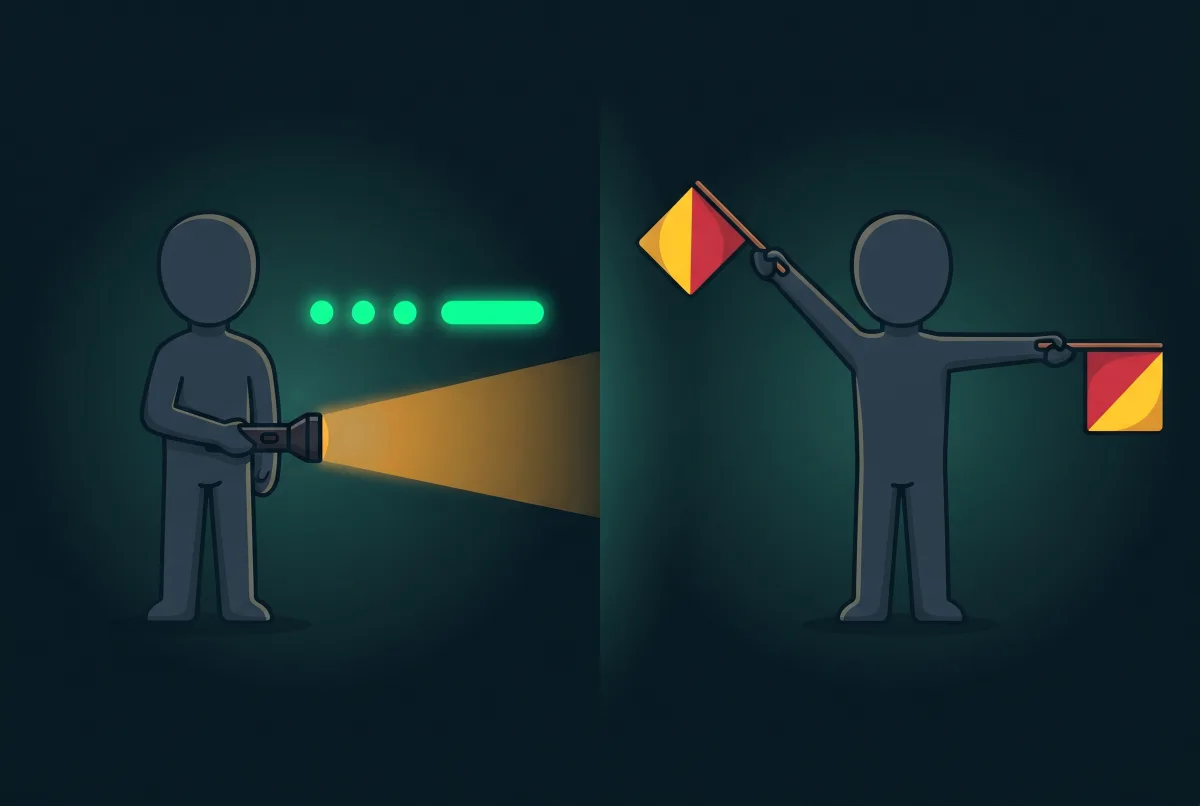
Scouts who pursue signaling deeply usually learn both. They solve different problems.
| Morse | Semaphore | |
|---|---|---|
| Equipment | Anything on/off (flashlight, whistle, tap) | Two flags or paddles |
| Time of day | Day or night | Daylight only |
| Through fog / smoke | Sound or radio works | No, visual only |
| Top speed | 5–35 WPM depending on operator | ~10 WPM |
| Learning curve | Steeper start (audio recognition), wider use | Easier start (positional, visual) |
Common Morse abbreviations for scouts
These are easy enough that scouts memorize them in one meeting and start using them on the air at JOTA.
- • CQ: calling any station ("seek you")
- • DE: "from" / this is
- • K: "go ahead" / over to you
- • TU: thank you
- • 73: best regards (always singular)
- • OM / YL: "old man" / "young lady" (friendly forms of address on air)
- • SOS: universal distress signal
- • SK: end of contact (signing off)
For scout leaders: how to teach Morse code well
The most common mistake leaders make is teaching the visual alphabet (a printed chart of dots and dashes) and asking scouts to "memorize" it. This is exactly backwards. Morse is a sound. Teach by ear from the start:
- • Use audio. Run the Audio Generator on a phone or laptop. Type words, play them, ask scouts to write down what they hear.
- • Two letters at a time. Don't overload. Master one pair (e.g., E and T) before adding the next (e.g., A and I).
- • Practice at target speed. Use 15 WPM character speed with Farnsworth-style gaps, not 5 WPM dragged-out characters. The fast characters train pattern recognition.
- • Mix sending and receiving. Scouts learn faster when they alternate roles. Sending solidifies what receiving teaches.
- • Make it social. Pair scouts up. The competitive element ("can you decode this faster?") motivates daily 10-minute practice in a way that solo study never will.
- • Celebrate small wins. The first time a scout decodes their own name from a flashlight at 30 feet, you've hooked them. The badge is almost an afterthought after that.
Frequently asked questions
Is Morse code required for any BSA merit badge?
Morse is one of three signaling-system options for the Signs, Signals, and Codes merit badge (requirement #5). The other options are American Sign Language and a foreign alphabet such as Braille. A scout who chooses Morse must send and receive a 20-word message at 5 WPM.
How fast does a scout need to send and receive Morse?
BSA's standard is 5 WPM send and receive, roughly one letter every 2.5 seconds. Most motivated scouts reach this pace within 2–4 weeks of 10–15 minute daily practice using the Koch method.
What's a good first Morse activity for a troop?
A flashlight relay: split into pairs across the meeting room, give each pair a short message to send. The other pair decodes. Repeat with longer messages. High energy, low equipment, works in any space.
What's the difference between Morse and semaphore?
Semaphore uses two flags in different positions to spell one letter at a time. It's a visual line-of-sight system. Morse uses time-based pulses sent by any on/off medium: sound, light, taps, radio. Morse works at night and through obstacles; semaphore is faster in good visibility. Many scouts learn both.
What is the scouting signaling history?
Robert Baden-Powell, Scouting's founder, included Morse and semaphore in the 1908 Scouting for Boys. The Signaler badge was a popular advancement from 1911 to 1992; the modern Signs, Signals, and Codes badge took over in 2015. Morse remains an honored tradition in BSA, Scouts UK, Scouts Canada, and World Scouting.
Get the MorseKit app for troop nights
Audio drills, a built-in trainer, and a flashlight signaler, all in your pocket. Perfect for campouts where you don't have Wi-Fi but you do have 14 scouts who want to try Morse.
Or use the Translator and Flashlight Signaler directly in your browser.
Author

MorseKit is built and maintained by Firstpoint. Every character table on the site follows ITU-R M.1677-1: the dot and dash ratios, the letter and word gaps, and the ITU punctuation set. One dataset drives the translator, the audio engine and the printable cheat sheets, so a correction reaches all three at once. Alongside International Morse the team maintains nine regional variants, including Wabun, Cyrillic, Greek and Arabic, plus 42 Q codes and 18 prosigns, and the same people build the MorseKit apps for iOS and Android. Where a fact rests on a published standard the guides cite it, and where something has not been verified the page says so.