

Morse Code for Preppers
Last updated:
Table of Contents
When the cell network goes down (for a day, a week, or longer), most people lose the ability to communicate beyond shouting distance. Preppers train for that gap. Morse code is one of the most redundant, lowest-tech, longest-range communication tools a self-reliant person can learn: it works on a 5-watt radio, on a flashlight, on a pencil tapped against a pipe, and on equipment you can build yourself.
Why Morse belongs in your communication plan
Modern communication is layered on fragile infrastructure: cell towers, internet backbones, satellite ground stations, undersea cables. A localized outage takes some of it down; a regional disaster takes most of it down; a serious grid failure takes all of it down. Voice radio helps, but it's still electronics. At very low signal strengths or high noise levels, voice becomes unintelligible.
Morse code (called CW on the air) has three properties that matter to preppers:
- • It gets through. A CW signal needs roughly 1/16 the bandwidth of an SSB voice signal, concentrating all your power into a narrow slice, a ~10–14 dB advantage over voice on the same path. Translation: a 5 W CW signal often beats a 100 W voice signal when conditions are bad.
- • It needs almost nothing. A handheld light, a whistle, a stick tapped on metal: anything that can be turned on and off can send Morse. If your radio dies, your skill doesn't.
- • It crosses language barriers. SOS, MAYDAY, and standard ham Q-codes are recognized worldwide. You don't need a shared spoken language to make a distress call understood.
The legal layer (US-focused)
For routine training and non-emergency communication, the FCC requires at least a Technician-class amateur radio license to transmit on the bands where Morse is practical. Most preppers go a step further and earn the General-class license, which unlocks the HF bands (80m, 40m, 20m) where CW reaches across continents.
Both Technician and General exams are 35-question multiple-choice tests; the question pools are public, and most adults pass after 1–3 weeks of self-study. The current pool removes the old 13/20 WPM code-test requirement entirely (dropped by the FCC in February 2007). You can be a fully licensed CW operator without ever sitting for a sending test.
The emergency exception
FCC Part 97.405 reads: "No provision of these rules prevents the use by an amateur station of any means of radio communication at its disposal to provide essential communication needs in connection with the immediate safety of human life and immediate protection of property when normal communication systems are not available."
In plain English: in a real emergency where life is at stake, you can transmit on any frequency by any means available, license or no license. This is a narrow exception meant for actual crises, not for skipping the test.
The minimum prepper Morse vocabulary
You don't need fluency to be useful. With about 12–15 hours of focused practice, you can learn enough Morse to call for help, identify yourself, exchange basic information, and copy a reply. Memorize this short list first:
| Send | Pattern | Meaning |
|---|---|---|
| SOS | ···———··· | Universal distress (sent as a single prosign, no gaps) |
| MAYDAY | —— ·— —·—— —·· ·— —·—— | Life-threatening emergency, request immediate help |
| HELP | ···· · ·—·· ·——· | Need assistance, not immediately life-threatening |
| MEDIC | —— · —·· ·· —·—· | Medical assistance required |
| FIRE | ··—· ·· ·—· · | Fire emergency |
| WATER | ·—— ·— — · ·—· | Need water / report water source |
| FOOD | ··—· ——— ——— —·· | Need food / report food cache |
| OK | ——— —·— | Status nominal / acknowledged |
| QSY | ——·— ··· —·—— | Change to frequency... |
| QRT | ——·— ·—· — | I am closing down / going silent |
You can verify any of these in our Morse Code Translator: type the word, hear it played at any speed, and download a .wav to practice from. Pair that with the Quiz to drill until recall is automatic.
Sending Morse without a radio
This is where Morse earns its place in a prepper kit. A radio can fail; the underlying skill carries across every other on/off medium you can improvise.
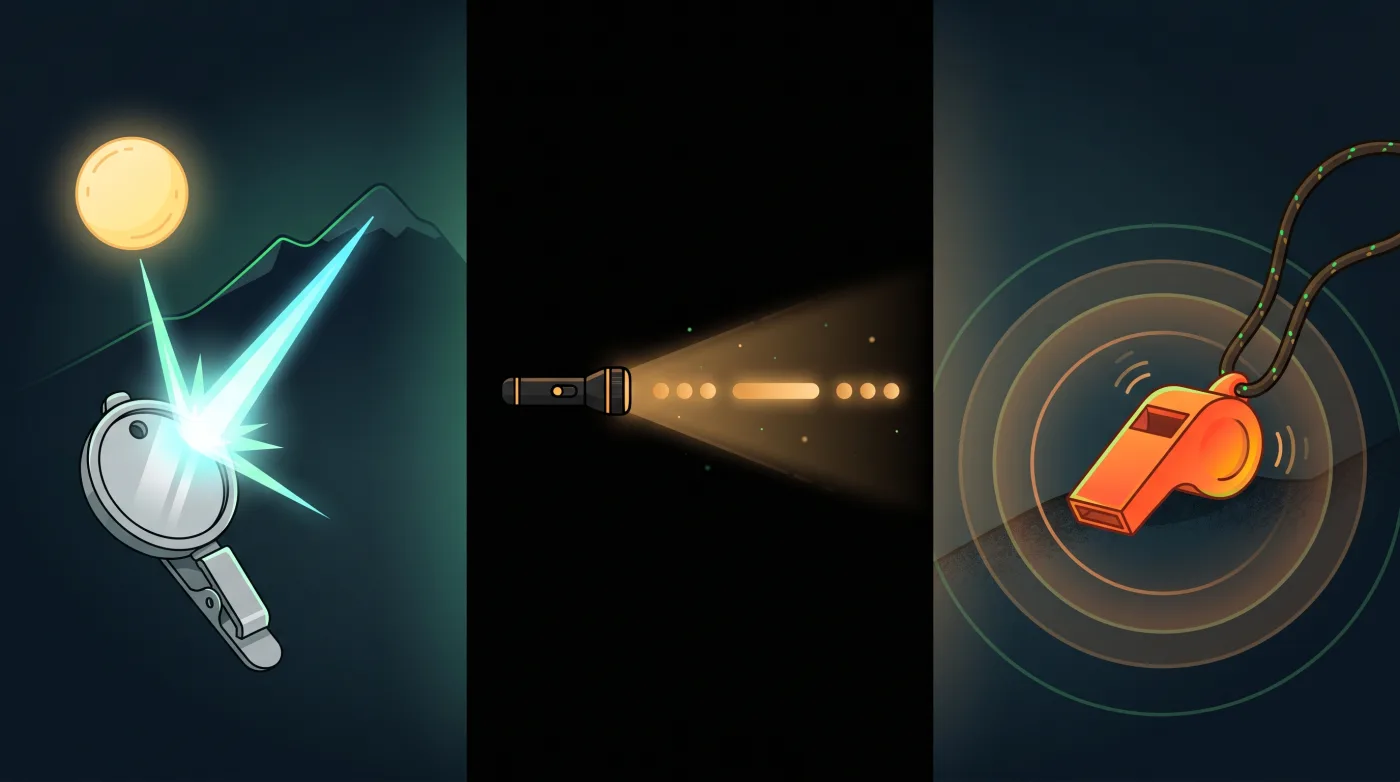
- • Flashlight or headlamp. Point at the receiver. Short flash = dot, long flash = dash. Effective at night up to several miles with a good torch. Use our Flashlight Signaler from a phone in your pocket. It does the timing for you and locks the screen with Wake Lock.
- • Whistle. Short pip = dot, long blast = dash. A whistle is in every survival kit; many people carry one without knowing they already have a Morse transmitter on a lanyard.
- • Signal mirror in sunlight. A 5×7 cm mirror with a sighting hole can flash a Morse signal to an aircraft or distant hilltop up to 10 miles away in clear conditions.
- • Tapping. Pencil, knuckle, or rock against a pipe, wall, or radiator. Standard in confined-space rescue: USAR teams listen for tapped patterns after structure collapses.
- • Smoke and fire. Cover and uncover a fire (or smoky source) with a damp cloth or board. Slow, but visible for miles in open terrain.
The skill is the same in every case: timing and pattern recognition. Once you can copy CW by ear at 10 WPM, every one of these media works for you with zero retraining.
Building a prepper radio kit
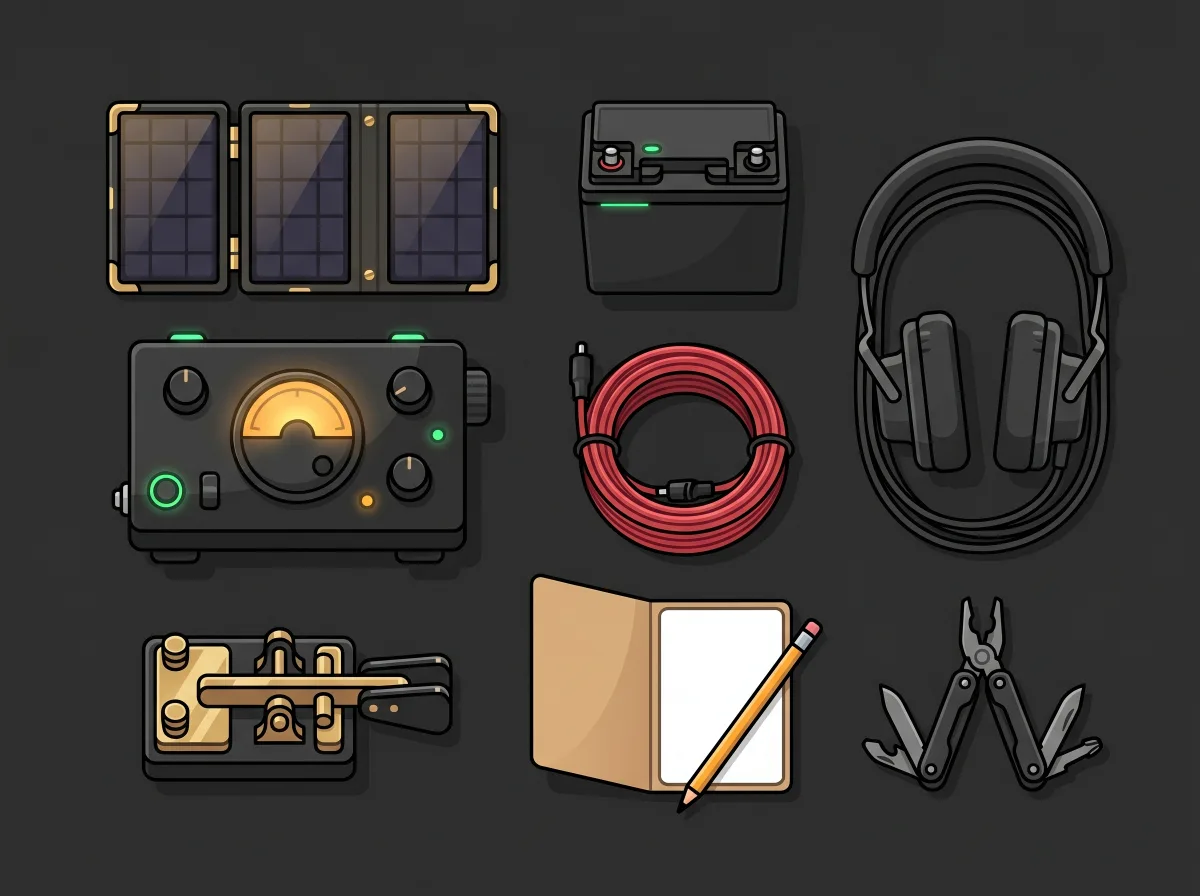
A practical off-grid CW station is smaller and cheaper than most people expect. Here is a battle-tested minimal kit that fits in a small messenger bag:
| Item | Purpose | Notes |
|---|---|---|
| QRP HF transceiver | Transmit / receive on 40m and 20m | Elecraft KX2, Yaesu FT-818, (tr)uSDX kit, Penntek TR-45L |
| Wire antenna | Radiate your 5 W | EFHW or random-wire with 9:1 unun; 20–40 m of wire |
| Paddle or straight key | Send Morse | Mini-paddle (Begali, N0SA) for portable use |
| Battery | Power source | LiFePO4 4.5–10 Ah; or 8× AA NiMH for ultralight |
| Small solar panel | Recharge battery | 10–20 W folding panel with USB and 12 V outputs |
| Earbuds / headphones | Hear weak signals | Mono adapter helpful; CW filter built into modern rigs |
| Paper notebook + pencil | Log contacts, copy traffic | Electronics fail; paper doesn't |
Total weight is around 1.5–3 kg depending on choices. Total cost ranges from roughly $400 (used FT-818 + DIY antenna) to $2,000+ (new Elecraft KX2 with accessories). Compared to the cost of most prepper categories, it's modest.
Emergency frequencies to know
Several frequencies are widely monitored by amateur emergency networks. None is exclusively yours, but these are good starting points:
- • 3.585 MHz CW: 80m emergency / national traffic system (NTS) calling
- • 7.040 MHz CW: 40m global QRP CW calling frequency
- • 7.114 MHz CW: 40m slow-CW / QRS calling
- • 14.060 MHz CW: 20m global QRP CW calling frequency
- • 14.300 MHz USB: Maritime Mobile Service Network (voice, monitored globally for distress)
- • 7.268 MHz LSB: Eastern US emergency net (voice)
A realistic learning plan for preppers
You don't need contest-grade speed. Aim for solid 10–13 WPM copy: enough to call CQ, exchange names and locations, and copy a coordinated message. With 20 minutes a day:
| Week | Goal |
|---|---|
| 1 | Learn SOS, your call/name, and digits 0–9 by ear at 15 WPM character speed |
| 2–3 | Add letters A–M (Koch method, 90% accuracy before adding new) |
| 4–5 | Add letters N–Z and basic punctuation (period, comma, question mark) |
| 6–8 | Drill the 30-word prepper vocabulary at 13 WPM until automatic |
| 9–12 | Practice sending (paddle or straight key) until your sending is readable |
| Month 4+ | Get on the air. Monthly SKCC events welcome slow operators |
Frequently asked questions
Why learn Morse code as a prepper when text and voice exist?
Morse works on equipment voice cannot: a 5 W radio, a flashlight, a whistle, a pencil tapped on a pipe. A weak HF Morse signal can cross continents on solar-charged batteries when cell networks and the internet are dark. It is the most redundant communication skill a prepper can learn.
Do I need a license to transmit Morse in an emergency?
No. FCC Part 97.405 explicitly permits anyone, licensed or not, to transmit on any frequency in a situation involving the immediate safety of human life. For routine practice and non-emergency use, you need at least a Technician-class amateur license. Most preppers earn General class for HF privileges.
What's the minimum Morse vocabulary for emergencies?
SOS, MAYDAY, HELP, MEDIC, FIRE, WATER, FOOD, OK, and your call sign or callout name. Memorize digits 0–9 for grid coordinates and counts. That covers 99% of survival messaging. About 12–15 hours of focused practice with the Koch method.
What radio works for prepper Morse?
QRP HF transceivers like the Yaesu FT-818, Elecraft KX2, or (tr)uSDX run on 5 W and a few AA cells. With a basic wire antenna they reach hundreds to thousands of miles on CW. Pair with a folding solar panel and you have communication that needs no infrastructure.
Can Morse code be sent without a radio?
Yes. That's why preppers learn it. Flashlight, headlamp, candle and shutter, whistle, signal mirror, pencil tapped on a pipe, hand squeezed on a shoulder. Anything that can be turned on and off carries Morse.
Practice when the internet is up, so you have it when it's not
The MorseKit app works offline. Drill the prepper vocabulary, run Koch sessions, and simulate flashlight signaling. No cell signal required after install.
Or start in your browser with the Flashlight Signaler and Quiz.
Author

MorseKit is built and maintained by Firstpoint. Every character table on the site follows ITU-R M.1677-1: the dot and dash ratios, the letter and word gaps, and the ITU punctuation set. One dataset drives the translator, the audio engine and the printable cheat sheets, so a correction reaches all three at once. Alongside International Morse the team maintains nine regional variants, including Wabun, Cyrillic, Greek and Arabic, plus 42 Q codes and 18 prosigns, and the same people build the MorseKit apps for iOS and Android. Where a fact rests on a published standard the guides cite it, and where something has not been verified the page says so.