

Morse Code for Ham Radio Operators
Last updated:
Table of Contents
Voice modes come and go. CW, the on/off keying of a carrier wave that hams have been calling "Morse code" for over a century, is still the most reliable, most efficient, and arguably most rewarding way to make a contact on HF. This guide is for licensed amateurs (or aspiring ones) who want a clear path from "I know SOS" to comfortably working DX at 20 WPM.
Why CW is still everywhere on the bands
Tune across 7.000–7.040 MHz on any evening and you'll hear it: the steady chorus of dits and dahs. CW survived the death of the Morse licensing requirement, the rise of FT8, and the explosion of digital modes for one simple reason: it works when nothing else does.
A CW signal occupies around 150 Hz of bandwidth. A single-sideband (SSB) voice signal needs about 2.4 kHz. That 16× concentration of transmitter power, combined with the human ear's remarkable ability to detect a steady tone buried in noise, gives CW roughly a 10–14 dB signal-to-noise advantage over voice on the same path. In practical terms: a 5-watt QRP rig running CW will routinely beat a 100-watt voice signal into the noise floor.
That's why every serious DXer, every contester, every QRP enthusiast, and every emergency communicator still has CW in their toolkit. It's why old-timers tap out three-letter abbreviations decade after decade. It's not nostalgia. It's physics.
The license history (and why it matters)
For most of the 20th century, a Morse code test was the gateway to HF privileges. The US required 13 WPM for the General class and 20 WPM for the Extra. Entire generations of hams learned the code because they had to.
The World Radiocommunication Conference of 2003 (WRC-03) made the Morse requirement optional. The FCC dropped it for all US license classes in February 2007; Ofcom (UK), RAC (Canada), the JARL (Japan), and most other national regulators followed within months. Today, you can hold a US Extra-class license without ever sending a single dit on the air.
What this changed
- • Many newer hams skip CW entirely. They don't realize what they're missing
- • The hams who choose to learn CW today tend to be passionate about it
- • CW segments of the band are quieter and friendlier than ever. Operators have time for slower newcomers
- • Clubs like FISTS, SKCC, CWops, and the QRP Quarterly community exist specifically to help new CW operators get on the air
Speed targets for ham CW
Unlike commercial telegraphy (which was largely 25–35 WPM territory), amateur CW happens at a wide range of speeds. Here's what each speed band gives you:
| Speed | What you can do |
|---|---|
| 5–10 WPM | Slow nets, Straight Key Century Club ragchews, learning |
| 13–15 WPM | First on-air QSOs, casual chats, regional traffic nets |
| 18–22 WPM | Comfortable DX, working pile-ups, most QRP operations |
| 25–30 WPM | Sprints, weekend contests, head-copying ragchews |
| 30+ WPM | CQ WW, ARRL DX, top-tier CW contesting |
How to learn CW (the proven way)
The single biggest mistake new ham CW learners make is studying a chart. Don't. CW is a sound-based skill, not a visual one. Looking at a dot-and-dash chart trains your eyes; what you need is to train your ears.
The gold standard is the Koch method: start at your target speed (e.g., 20 WPM character speed, 10 WPM effective via Farnsworth spacing), learn two characters until you can copy them at 90% accuracy, then add one more. Repeat until all 40 characters (A–Z, 0–9, and four punctuation marks: period, comma, question mark, slash) are locked in.
Pair this with our Morse Code Audio Generator to drill at the exact WPM and pitch you'll hear on the radio. Most operators run around 600–750 Hz. Practice at that pitch from day one so your ear builds the right reference. For structured drills with progress tracking, our Morse Code Quiz includes character, word, and speed-test modes.
Q-codes: the lingua franca of CW
Q-codes are three-letter abbreviations starting with Q. They were invented to compress common radio phrases into rapid Morse exchanges, and they're still the backbone of every CW QSO. Memorize this short list and you can hold a basic conversation in any country:
| Code | Meaning |
|---|---|
| QRP | Reduce power / I am running low power |
| QRO | Increase power / High power |
| QRM | Interference (man-made) |
| QRN | Static / atmospheric noise |
| QRS | Send slower, please |
| QRQ | Send faster |
| QRT | Stop transmitting / I'm closing down |
| QRZ | Who is calling me? |
| QSB | Signal is fading |
| QSL | I acknowledge receipt / Confirm contact |
| QSO | A radio conversation |
| QSY | Change frequency |
| QTH | My location is... |
| QRX | Wait / Stand by |
The full ITU list runs to over 100 codes. For an expanded reference with examples, browse our Academy Q-codes section.
Prosigns and procedural shorthand
Prosigns are special character combinations sent without the usual gap. They have specific procedural meanings. The most important ones for everyday CW:
- • CQ: calling any station ("seek you")
- • DE: "from" (separates the called from the calling station)
- • K: invitation to transmit (back to you, anyone)
- • KN: invitation to a specific station only ("over to you, no breakers")
- • AR (·—·—·): end of message
- • SK (···—·—): end of contact, going clear
- • BT (—···—): separator / "new paragraph"
- • 73: best regards (singular, never "73s")
- • 88: love and kisses (used among close friends or romantic partners on air)
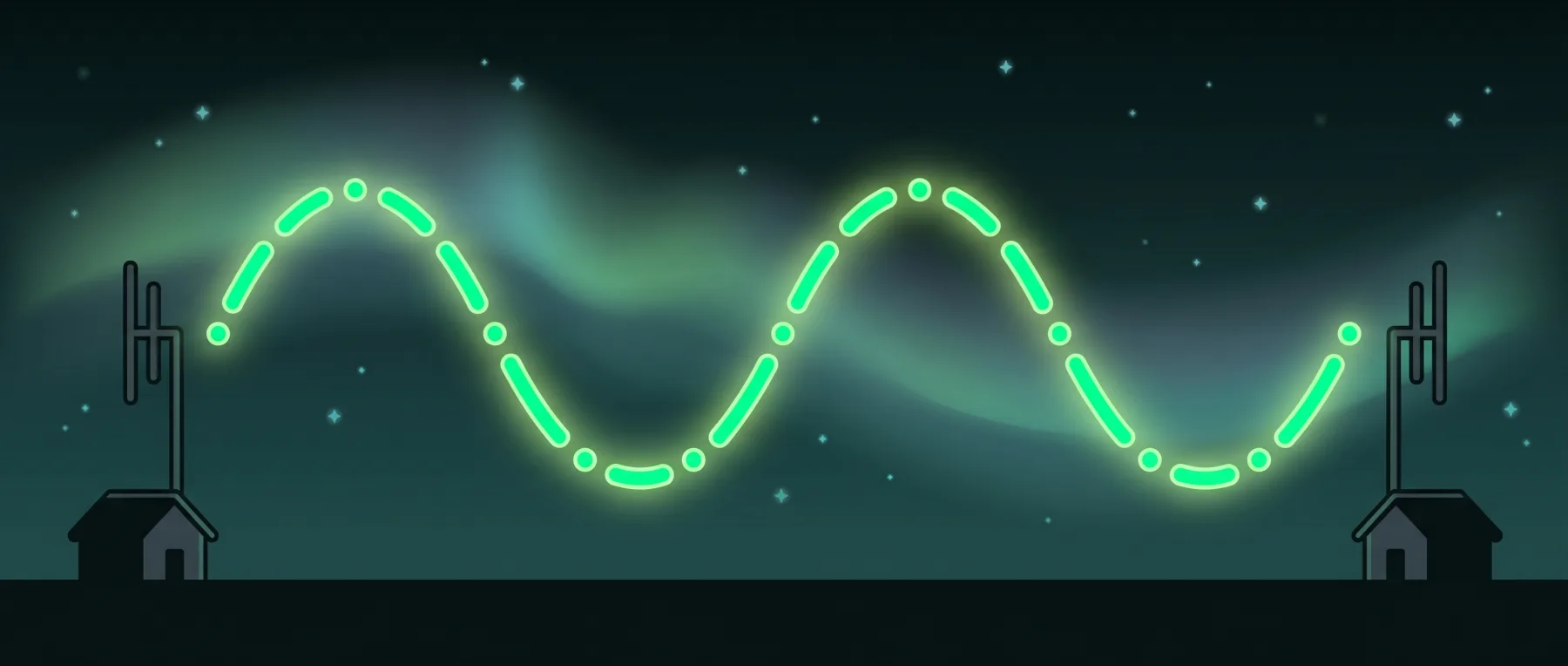
A typical CW QSO, decoded
Here's what a basic CW contact actually sounds like, line by line, with what each part means:
W1AW calls CQ, identifies themselves three times, invites any station to respond.
K3LR answers, naming W1AW first, then their own callsign.
W1AW: Good evening, old man. Thanks for the call. Your signal is RST 599. Name is Joe. Location is Newington, CT. How copy? Over.
K3LR: Thanks Joe, your signal here is 579. I'm Jim from Pittsburgh, running an IC-7300 at 100 W into a dipole. Back to you.
Best regards, good luck, and thank you for the QSO. End of contact.
That's the entire skeleton. A solid first contact takes about 3–5 minutes at 15 WPM. Once you have the structure memorized, every callsign you work fills the same slots. You stop "translating" and start conversing.
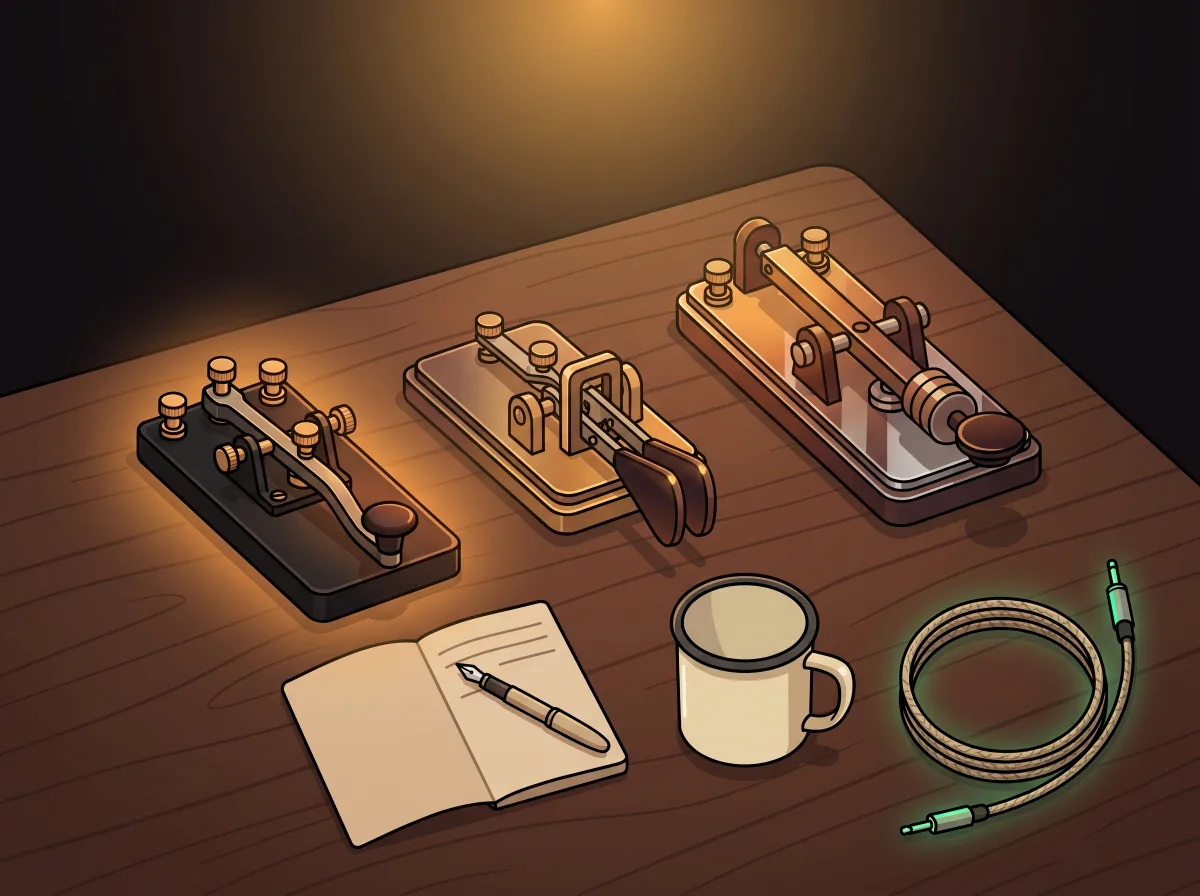
Choosing a key
Three options dominate. None is wrong; they suit different goals.
- • Straight key. A simple lever you push down. Tradition, low cost ($30–80 new), and the only key allowed in SKCC contacts. Tops out at around 18–20 WPM before fatigue sets in.
- • Iambic paddle + electronic keyer. Two levers (dot side, dash side). Squeeze both for alternating "didahdidah." Modern keyers built into rigs like the IC-7300, FT-991A, or KX3 handle all the timing. The standard for 18+ WPM operation.
- • Bug (semi-automatic key). A horizontal mechanical key with a vibrating arm that makes dots automatically while you manually form dashes. Beloved by traditionalists; takes serious practice to send legibly.
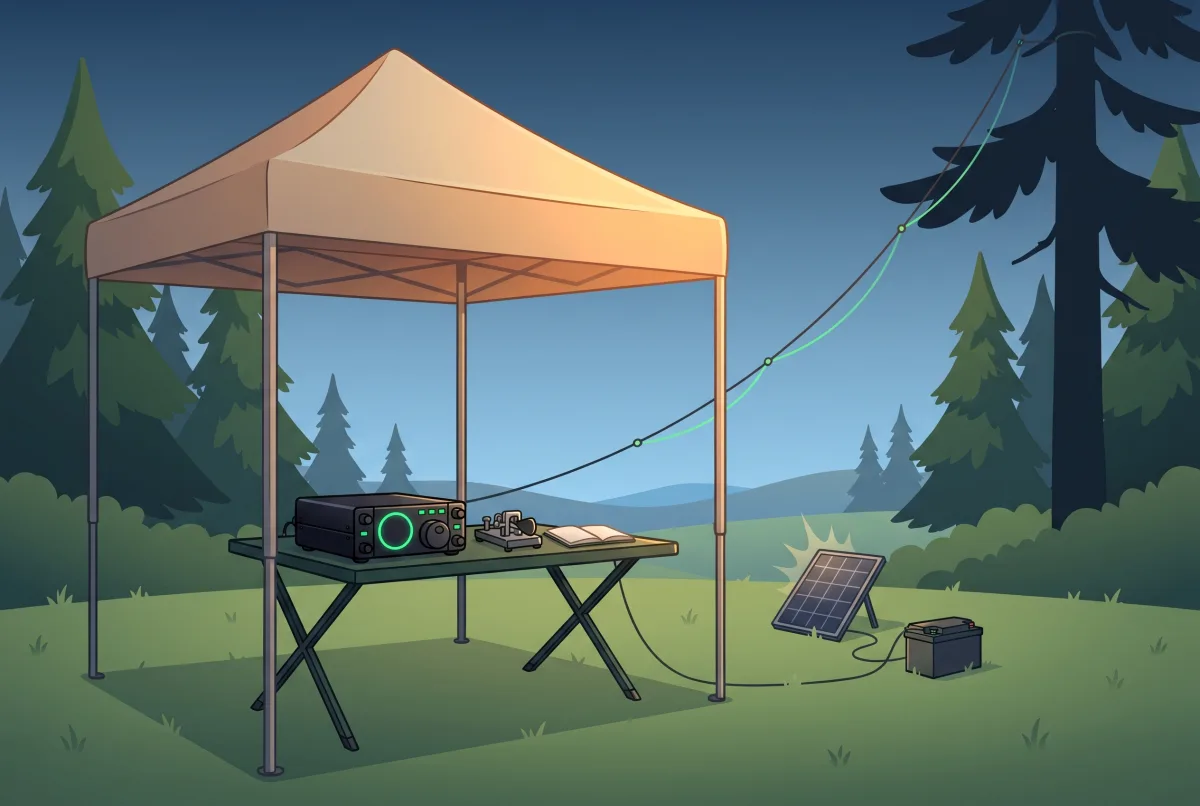
Where to get on the air
Once you can copy reliably at 13 WPM, get on the air. Lurking on frequency reading mail will not turn into operating skill. Only QSOs do that.
- • SKCC Weekend Sprintathon (WES). Monthly, friendly, slower speeds welcome.
- • CWops CWT mini-contests. One-hour weekly sessions at multiple speed levels.
- • QRS portion of the bands. 7.114, 14.114, 21.114 MHz: slow CW calling frequencies.
- • Parks On The Air (POTA). Activators love CW because it travels further on low power. New operators are welcomed.
- • Field Day (June). CW contacts count for more points; clubs are usually happy to coach a new operator.
Frequently asked questions
Do I still need to pass a Morse code test for a ham radio license?
No. The ITU dropped the Morse code requirement from amateur licensing at WRC-03, and the FCC followed in February 2007. CW is now entirely voluntary, but it remains one of the most popular operating modes on HF.
What speed should I aim for as a new ham CW operator?
Start by reliably copying random callsigns and exchanges at 15–18 WPM. That's enough for ragchews, slow nets, and most casual contacts. 20–25 WPM opens DX pile-ups; 25–35 WPM is contest territory.
Straight key, paddle, or bug: which should I learn first?
Most modern hams start with a single-lever or iambic paddle plus an electronic keyer. Straight keys are great for slow ragchewing and tradition, but paddles dramatically reduce wrist fatigue at 18+ WPM.
Why does CW get through when SSB voice doesn't?
A CW signal occupies roughly 150 Hz of bandwidth versus 2.4 kHz for SSB voice. All your transmitter power concentrates into a much narrower slice. Combined with the brain's ability to lock onto a steady tone in noise, this gives CW a 10–14 dB advantage. A 5 W CW signal often beats a 100 W voice signal on a weak path.
How long does it take to get on the air with CW?
With 20 minutes of daily Koch-method practice, most adult learners copy all 40 characters within 4–6 weeks and make their first on-air contact within 2–3 months. A comfortable 18 WPM typically takes 6–9 months of consistent practice.
Practice anywhere with the MorseKit app
Take your CW drills off the desktop. Koch-method trainer, adjustable WPM and pitch, and offline practice. Perfect for portable ops and POTA waits.
Prefer the web tools? Start with the Audio Generator or test yourself with the Quiz.
Author

MorseKit is built and maintained by Firstpoint. Every character table on the site follows ITU-R M.1677-1: the dot and dash ratios, the letter and word gaps, and the ITU punctuation set. One dataset drives the translator, the audio engine and the printable cheat sheets, so a correction reaches all three at once. Alongside International Morse the team maintains nine regional variants, including Wabun, Cyrillic, Greek and Arabic, plus 42 Q codes and 18 prosigns, and the same people build the MorseKit apps for iOS and Android. Where a fact rests on a published standard the guides cite it, and where something has not been verified the page says so.