

How Morse Code Works
Last updated:

Table of Contents
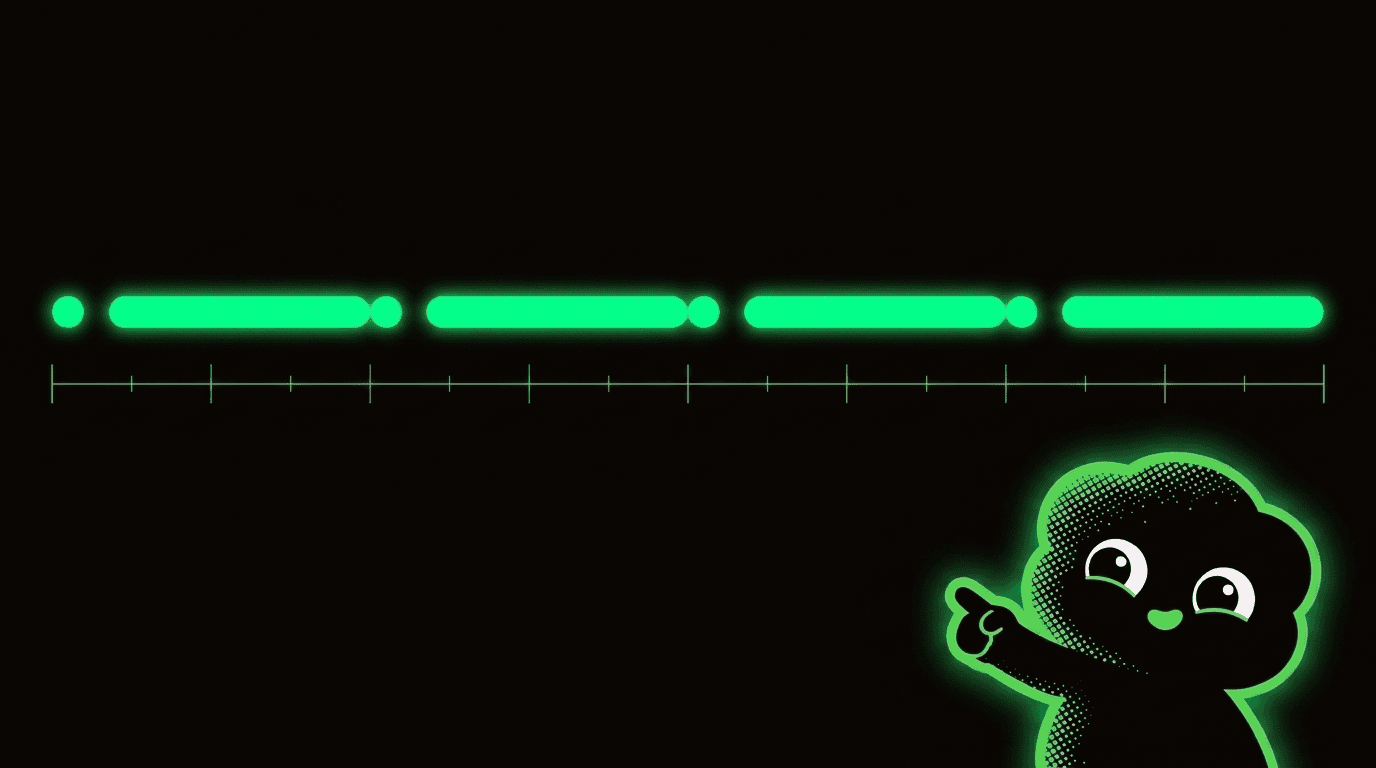
Morse code uses only two signal elements: a short signal called a dit (dot, ·) and a long signal called a dah (dash, —). The entire system relies on precise timing relationships between these elements. Per the ITU-R M.1677-1 standard, one dah lasts exactly three dit units, the gap inside a letter is one dit, between letters three dits, and between words seven dits.
The Timing Rules
Everything in Morse code is measured relative to the dot duration, the shortest unit. All other timings are multiples of this unit:
| Element | Duration | Visual |
|---|---|---|
| Dot (dit) | 1 unit | |
| Dash (dah) | 3 units | |
| Gap between elements (within a letter) | 1 unit | silence |
| Gap between letters | 3 units | short pause |
| Gap between words | 7 units | long pause |

Example: Sending "HI"
H = ···· (four dots)
I = ·· (two dots)
Transmission: dit gap dit gap dit gap dit (letter gap) dit gap dit
Units: 1·1·1·1·1·1·1, 3, 1·1·1 = 17 units total
Measuring Speed: Words Per Minute (WPM)
Morse code speed is measured in Words Per Minute (WPM). The standard reference word is PARIS, which contains exactly 50 dot-units when including all internal and word spacing.
This means at 20 WPM, the word PARIS is transmitted 20 times per minute, giving a dot duration of 60ms (1.2 seconds ÷ 20).
Speed Reference
5 WPM: Beginner (dot = 240ms)
13 WPM: Former FCC license requirement (dot = 92ms)
20 WPM: Proficient operator (dot = 60ms)
30 WPM: Expert / contest speed (dot = 40ms)
40+ WPM: High-speed CW (characters blur together)
Which word measures Morse code speed? The unit-by-unit breakdown of PARIS, and where the 1200 / WPM formula comes from.
Frequency and Tone
When transmitted by radio, Morse code is sent as a continuous wave (CW) signal. The receiver produces an audible tone, typically between 400 Hz and 1000 Hz. Most operators prefer a tone around 600–700 Hz, which sits in a comfortable range for the human ear and cuts through background noise effectively.
Character Design Logic
Morse code was designed with efficiency in mind. The most frequently used letters in English have the shortest codes:
The ITU Standard
The International Telecommunication Union (ITU) maintains the official standard for International Morse Code under Recommendation ITU-R M.1677. This standard defines character assignments, timing rules, and operating procedures used globally.
Ready to start? Learn the proven methods →
Author

MorseKit is built and maintained by Firstpoint. Every character table on the site follows ITU-R M.1677-1: the dot and dash ratios, the letter and word gaps, and the ITU punctuation set. One dataset drives the translator, the audio engine and the printable cheat sheets, so a correction reaches all three at once. Alongside International Morse the team maintains nine regional variants, including Wabun, Cyrillic, Greek and Arabic, plus 42 Q codes and 18 prosigns, and the same people build the MorseKit apps for iOS and Android. Where a fact rests on a published standard the guides cite it, and where something has not been verified the page says so.